
Latest Version
Update
October 03, 2026
October 03, 2026
Developer
Lanchas Dev
Lanchas Dev
Categories
Education
Education
Platforms
Android
Android
Downloads
0
0
License
Free
Free
Package Name
com.bydark.traditional.chinese.acupuncture
com.bydark.traditional.chinese.acupuncture
Report
Report a Problem
Report a Problem
More About TCM: Acupuncture & Acupressure
Acupoints index, acupuncture points and acupressure points app in one TCM guide: tongue and pulse diagnosis, Yin Yang, Qi Gong, Chinese herbal medicine and holistic health.
Study acupuncture points and acupoints, acupressure and pressure points, meridians, Chinese herbs and formulas, tongue diagnosis, pulse reading, Yin Yang theory, Five Elements and Qi Gong — one structured reference built for progressive learning. It works offline: the whole TCM library lives on your device.
Whether you are studying for a TCM exam, reviewing clinical patterns or new to eastern medicine, the path through Chinese medicine is laid out by level.
📍 ACUPUNCTURE POINTS, ACUPOINTS & ACUPRESSURE
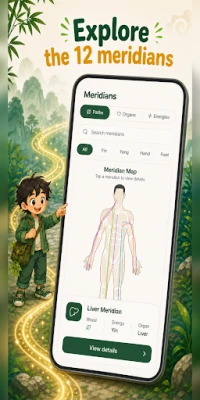
An atlas of acupuncture points and meridian theory: the twelve primary meridians and the eight extraordinary vessels, each with its pathway and function.
For every point: exact location, function, category (Source, Luo, Xi-Cleft, Influential, Command) and clinical use. The point locator finds any of them by name, meridian or symptom.
Acupressure is the needle-free complement: the same meridian map applied by hand. Pressure points for back pain, neck pain, knee pain, headache, sleep, digestion, bloating and constipation are flagged for daily self-care.
Microsystems with their own charts: ear (auriculotherapy), scalp, hand, abdomen and face.
🌿 CHINESE HERBS, FORMULAS & CHINESE NUTRITION
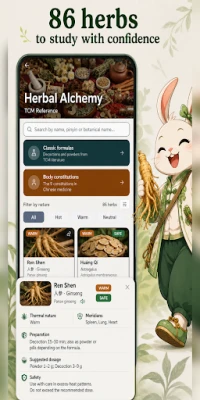
A complete profile for every herb: taste, temperature, organ and meridian entry, functions, category, dosage and preparation. Categories run from releasing the exterior and clearing heat to draining dampness and tonifying Yin and Yang.
How herbs combine in classic formulas: the Chief, Deputy, Assistant and Envoy roles, the logic behind every formula in Chinese herbal medicine.
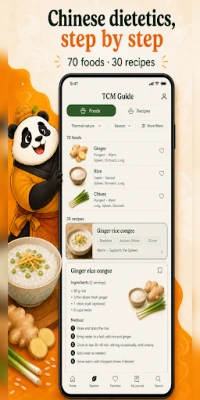
Chinese dietetics applies that logic to the plate: the energetic nature of each ingredient and which foods suit a pattern.
👅 TONGUE DIAGNOSIS, PULSE READING & ZANG FU
Tongue — colour, shape and coating, with the regional map: tip → Heart and Lung · middle → Spleen and Stomach · rear → Kidney · sides → Liver and Gallbladder.
Pulse — floating, deep, rapid, slow, slippery, wiry, tight, choppy, weak, empty, full and fine, with the three wrist positions and their organs.
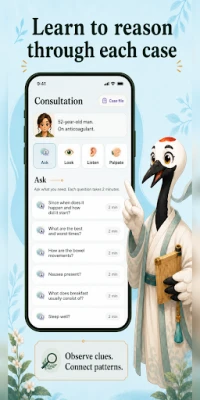
The Eight Principles and Zang Fu syndromes tie the signs into a pattern, and 18 clinical cases let you practise reading one from start to finish.
☯️ YIN, YANG, QI & FIVE ELEMENTS
Yin Yang theory: opposition, interdependence and transformation, with the deficiency and excess patterns of each. Qi types (Yuan, Zong, Ying, Wei) and its pathologies — deficiency, stagnation, rebellious Qi — with Blood, Body Fluids and Essence.
The Five Elements (Wood, Fire, Earth, Metal, Water) organize all of TCM: paired organs, emotion, season, tissue and colour, with the generating (Sheng) and controlling (Ke) cycles.
Body constitutions explain why the same complaint reads differently in each person: brain fog, low energy, PMS and period pain, a blocked sinus, tinnitus, a common cold that never clears, a fragile immune system or menopause.
🧘 QIGONG, GUA SHA, MOXIBUSTION & CUPPING
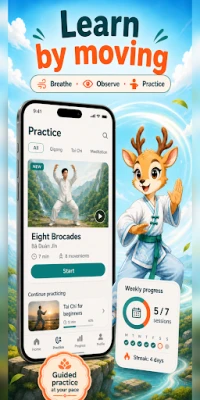
Qigong expresses TCM principles through movement and breath: Ba Duan Jin (the Eight Brocades), Wu Qin Xi, Liu Zi Jue and Yi Jin Jing, with the theory of cultivating qi energy for natural healing, holistic health.
External therapies, each with its own guide: gua sha for body and face, moxa therapy, cupping and tui na massage.
✨ FEATURES
A searchable acupoints index runs through the whole guide: type a point on the meridian chart, a herb or a symptom and jump straight to it. Flashcards and quizzes on meridians, points, herbs and formulas for exam review, full-text search and progress tracking — a TCM encyclopedia that needs no connection. In 11 languages, including Spanish: medicina china y fitoterapia china.
⚠️ Educational purposes only. This app does not provide medical advice, diagnosis or treatment, and is no replacement for professional consultation.
Whether you are studying for a TCM exam, reviewing clinical patterns or new to eastern medicine, the path through Chinese medicine is laid out by level.
📍 ACUPUNCTURE POINTS, ACUPOINTS & ACUPRESSURE
An atlas of acupuncture points and meridian theory: the twelve primary meridians and the eight extraordinary vessels, each with its pathway and function.
For every point: exact location, function, category (Source, Luo, Xi-Cleft, Influential, Command) and clinical use. The point locator finds any of them by name, meridian or symptom.
Acupressure is the needle-free complement: the same meridian map applied by hand. Pressure points for back pain, neck pain, knee pain, headache, sleep, digestion, bloating and constipation are flagged for daily self-care.
Microsystems with their own charts: ear (auriculotherapy), scalp, hand, abdomen and face.
🌿 CHINESE HERBS, FORMULAS & CHINESE NUTRITION
A complete profile for every herb: taste, temperature, organ and meridian entry, functions, category, dosage and preparation. Categories run from releasing the exterior and clearing heat to draining dampness and tonifying Yin and Yang.
How herbs combine in classic formulas: the Chief, Deputy, Assistant and Envoy roles, the logic behind every formula in Chinese herbal medicine.
Chinese dietetics applies that logic to the plate: the energetic nature of each ingredient and which foods suit a pattern.
👅 TONGUE DIAGNOSIS, PULSE READING & ZANG FU
Tongue — colour, shape and coating, with the regional map: tip → Heart and Lung · middle → Spleen and Stomach · rear → Kidney · sides → Liver and Gallbladder.
Pulse — floating, deep, rapid, slow, slippery, wiry, tight, choppy, weak, empty, full and fine, with the three wrist positions and their organs.
The Eight Principles and Zang Fu syndromes tie the signs into a pattern, and 18 clinical cases let you practise reading one from start to finish.
☯️ YIN, YANG, QI & FIVE ELEMENTS
Yin Yang theory: opposition, interdependence and transformation, with the deficiency and excess patterns of each. Qi types (Yuan, Zong, Ying, Wei) and its pathologies — deficiency, stagnation, rebellious Qi — with Blood, Body Fluids and Essence.
The Five Elements (Wood, Fire, Earth, Metal, Water) organize all of TCM: paired organs, emotion, season, tissue and colour, with the generating (Sheng) and controlling (Ke) cycles.
Body constitutions explain why the same complaint reads differently in each person: brain fog, low energy, PMS and period pain, a blocked sinus, tinnitus, a common cold that never clears, a fragile immune system or menopause.
🧘 QIGONG, GUA SHA, MOXIBUSTION & CUPPING
Qigong expresses TCM principles through movement and breath: Ba Duan Jin (the Eight Brocades), Wu Qin Xi, Liu Zi Jue and Yi Jin Jing, with the theory of cultivating qi energy for natural healing, holistic health.
External therapies, each with its own guide: gua sha for body and face, moxa therapy, cupping and tui na massage.
✨ FEATURES
A searchable acupoints index runs through the whole guide: type a point on the meridian chart, a herb or a symptom and jump straight to it. Flashcards and quizzes on meridians, points, herbs and formulas for exam review, full-text search and progress tracking — a TCM encyclopedia that needs no connection. In 11 languages, including Spanish: medicina china y fitoterapia china.
⚠️ Educational purposes only. This app does not provide medical advice, diagnosis or treatment, and is no replacement for professional consultation.
Rate the App
Add Comment & Review
User Reviews
Based on 0 reviews
No reviews added yet.
Comments will not be approved to be posted if they are SPAM, abusive, off-topic, use profanity, contain a personal attack, or promote hate of any kind.









More »

Popular Apps

phpFoxPHPFOX LLC

Moon Chai StoryOlha Dobel

World War Heroes — WW2 PvP FPSAzur Interactive Games Limited

Govee LiteGovee

Viking Clan: RagnarokKano Games

Build World AdventureExplore city in cube world

Vikings: War of ClansPlarium LLC

AvSeaAvionics Electronics Geeks!

Asphalt 9: LegendsGameloft SE

Dawn of Zombies: Survival GameRoyal Ark
More »
Editor's Choice

Grim Soul: Dark Survival RPGBrickworks Games Ltd

Craft of Survival - Gladiators101XP LIMITED

Last Shelter: SurvivalLong Tech Network Limited
Dawn of Zombies: Survival GameRoyal Ark

Merge Survival : WastelandStickyHands Inc.

AoD Vikings: Valhalla GameRoboBot Studio
Viking Clan: RagnarokKano Games
Vikings: War of ClansPlarium LLC
Asphalt 9: LegendsGameloft SE
Modern Tanks: War Tank GamesXDEVS LTD